
Barcelona has become one of those cities people keep putting on their “maybe I should live there for a while” list. And honestly, it is not hard to understand why. The sea is close. The weather helps. The startup scene is active. The city is international without feeling as huge as London or Paris. You can work seriously and still walk by the beach after a long day of calls.
But choosing the right coliving space in Barcelona is not as simple as picking the prettiest room on a website.
Some spaces are great for digital nomads who want community and flexibility. Others are better for students. Some are stronger for coworking. Some are closer to serviced apartments. Some are central and social, but not ideal if you need quiet. Some are outside the city centre, but offer a much better daily rhythm if you work remotely full time.
So the real question is not “what is the best coliving in Barcelona?” That is too simple.
Don’t choose the best coliving. Choose the best coliving for your routine.
Because the right place is not always the most central, the most social or the most beautiful. It is the one that fits the way you actually live: your calls, your sleep, your budget, your need for quiet, your desire for community and how often you really want to be in the city centre.
This guide compares several real coliving operators in Barcelona using the same criteria: location, work setup, community, privacy, sustainability, facilities, value for money and lifestyle fit. The goal is not to push one option. The goal is to help you avoid choosing the wrong one.
If you are still learning how coliving works in the city, start with our full guide to coliving in Barcelona. This article is for the next step: comparing options before you book.
Quick answer: what is the best coliving space in Barcelona?
There is no single best coliving space in Barcelona for everyone. Green Living is a strong fit for remote workers who want coworking, sustainability, beach access and a calmer Greater Barcelona routine. Aticco Living works well for people who want central locations and access to a larger coworking ecosystem. CoImpact is a good option for social short or medium stays in Eixample. The Social Hub fits people who want a hotel-style extended stay with coworking and many facilities. Outsite suits digital nomads who prefer a global remote-work brand and central city access. The best choice depends on your work setup, budget, privacy needs and preferred lifestyle.
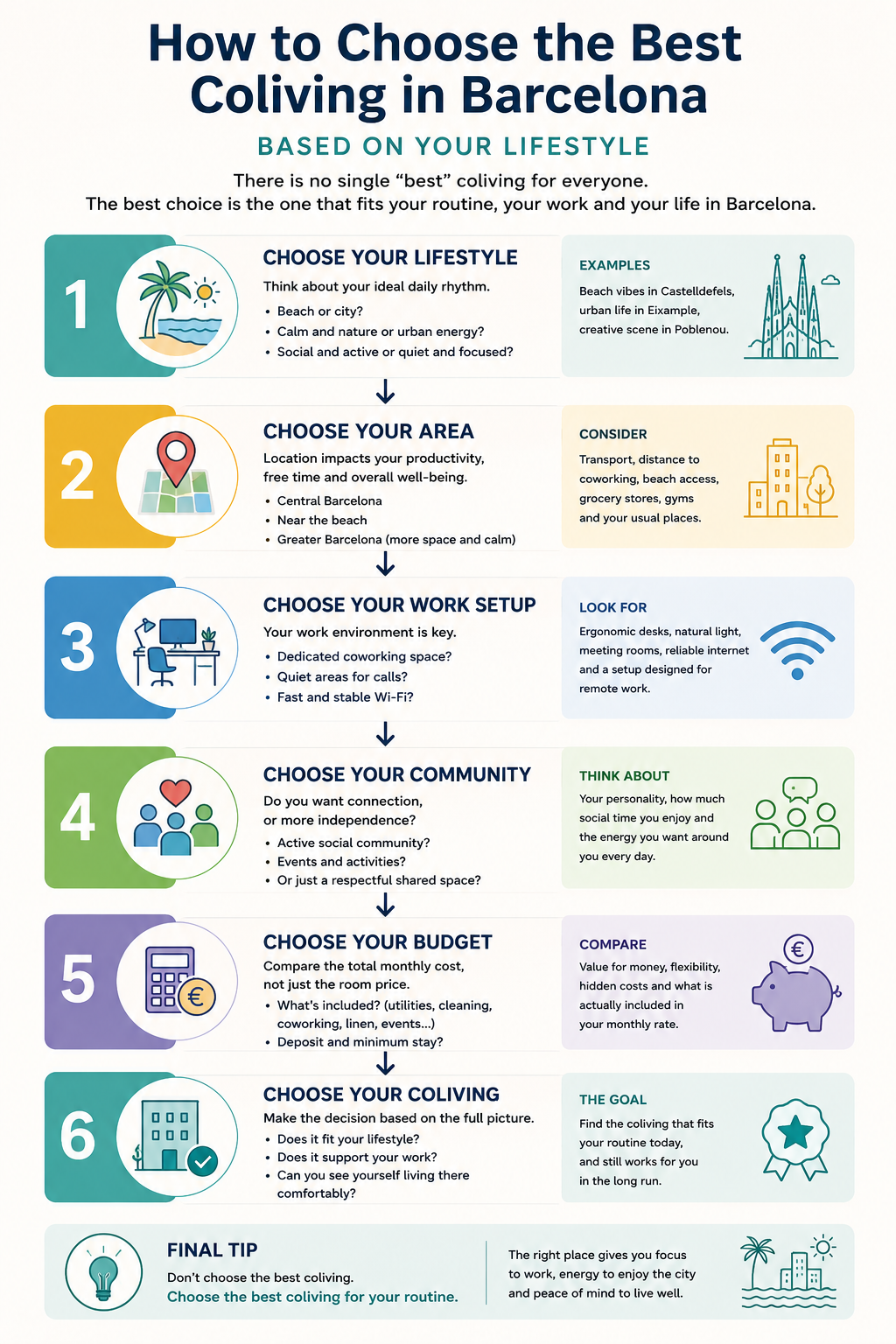
Table of contents
- Why trust this guide?
- How we evaluated each coliving
- How to compare colivings in Barcelona properly
- Before you choose: the 7-question filter
- The main types of coliving in Barcelona
- Barcelona coliving comparison by lifestyle fit
- Quick comparison table
- Green Living Coliving & Coworking
- Where Green Living fits
- Aticco Living
- CoImpact Coliving
- Outsite Barcelona
- The Social Hub Barcelona Poblenou
- Circles House
- Enso Coliving
- Citizenelles Living
- Episode Barcelona
- Which coliving is best for each profile?
- Comparison matrix
- FAQs
- Final recommendation
Why trust this guide?
Many “best coliving” articles are basically lists. A name, a photo, a few nice words, next. That does not help much when you are about to spend one, three or six months somewhere.
This guide uses a more practical approach. We compare the type of resident each space is best suited for, the kind of work setup it offers, the level of privacy, the location, the services included and the likely trade-offs. Because there are always trade-offs. Centrality usually means more noise. Community can mean less privacy. Lower price can mean fewer facilities. Premium design does not always mean better daily life.
Green Living is itself a coliving operator in Metropolitan Barcelona, so we know this market from the inside. That also means we need to be extra careful. This is not an article claiming that Green Living is automatically the best option. It is a comparison designed to help the reader choose well, even if that choice is another operator.
All operator information below is based on publicly available information from official websites and clearly identified sources at the time of review. Prices and availability change quickly, so always check the operator’s live booking page before making a decision.
How we evaluated each coliving
Instead of giving fake precision with scores like 8.7 or 9.4, we use a transparent fit-based evaluation. It is more honest. A coliving can be excellent for one person and wrong for another.
For example, a central Eixample coliving may be perfect for someone who wants nightlife, cafés and social energy. The same place may be tiring for a remote worker who needs silence and long focus blocks. A beach-adjacent coliving may be ideal for wellbeing, but less convenient for someone who needs to be in the city centre three times a day.
We used the following criteria:
| Criterion | Weight in decision-making | What it means |
|---|---|---|
| Work environment | 20% | Internet, desks, coworking, call areas and ability to work full time. |
| Community | 15% | How naturally residents can meet without feeling forced into constant activity. |
| Privacy | 10% | Private rooms, bathrooms, quiet time and ability to switch off. |
| Sustainability | 10% | Energy efficiency, responsible design, resource sharing and environmental commitment. |
| Location | 15% | Neighbourhood fit, transport, beach access, city access and daily convenience. |
| Facilities | 10% | Kitchens, gym, laundry, terraces, social areas, parking or extra services. |
| Value for money | 10% | What is included beyond the room: utilities, cleaning, coworking, flexibility and support. |
| Flexibility | 10% | Minimum stay, booking process, contract clarity and suitability for temporary stays. |
We call this the Green Living Fit Matrix. It is not a ranking system. It is a way to ask better questions.
How to compare colivings in Barcelona properly
Most people compare colivings in the wrong order. They start with photos, then price, then location. It feels logical, but it often leads to bad decisions.
A better way is to start with your routine. Will you work from home every day? Do you need quiet calls? Do you want nightlife nearby, or would you rather sleep well and go to the beach before work? Are you looking for a strong social scene, or simply a respectful shared environment where you can meet people naturally?
That is why this guide does not use a fake ranking. There is no universal “best coliving in Barcelona”. There is a best fit depending on your lifestyle, your work rhythm and the type of stay you are planning.
Don’t choose the best coliving. Choose the best coliving for your routine.
We compared Barcelona coliving spaces using five practical criteria:
| Criterion | What to check | Why it matters |
|---|---|---|
| Location | Central Barcelona, Poblenou, Eixample, Gràcia, Castelldefels or Greater Barcelona | Your area defines your rhythm, transport, noise, lifestyle and free time. |
| Work setup | Desk, Wi-Fi, coworking, meeting rooms, call areas and quiet zones | If you work remotely full time, this matters more than decoration. |
| Community | Social activities, shared routines, common spaces and resident profile | Community can be valuable, but only if it matches your personality. |
| Privacy | Private room, bathroom type, number of residents and noise levels | Even social people need space to rest, work and disconnect. |
| Lifestyle fit | Beach, city, startup network, student life, wellness, budget or premium comfort | The right coliving should support the life you actually want to live. |
Before you choose: the 7-question filter
Before comparing names, prices and photos, answer these questions honestly. They will tell you more than any ranking.
| Question | Why it matters |
|---|---|
| Will you work from home every day? | If yes, coworking quality matters more than decoration. |
| Do you need silence for calls or deep work? | Some social colivings are great for meeting people, but not ideal for focus. |
| Do you want beach lifestyle or city energy? | Barcelona city and Greater Barcelona offer very different routines. |
| Do you need a private bathroom? | This can change both comfort and price quickly. |
| Will you use facilities like gym, terrace or coworking? | Included services only have value if they fit your real week. |
| Do you want community, or just accommodation? | Not everyone wants the same level of social life. |
| What is your real monthly budget after extras? | Compare rent, utilities, cleaning, coworking, deposit and transport together. |
If you are unsure about most of these answers, do not book the most attractive option. Book the option with the clearest routine.
The main types of coliving in Barcelona
Barcelona is not one single coliving market. A room in Eixample, a startup-focused space in Poblenou and a beach-oriented coliving in Castelldefels are not solving the same problem. They may all be called “coliving”, but the daily experience can be completely different.
1. Central urban coliving
These colivings are usually located in areas like Eixample, Gràcia or central Barcelona. Their biggest advantage is obvious: you are close to cafés, restaurants, nightlife, public transport and the classic Barcelona lifestyle.
The trade-off? Less space, more noise, smaller rooms and less mental separation between work and city life. This setup can be great if you are staying for a short period and want intensity. It can be tiring if you work remotely full time and need calm.
2. Startup and networking coliving
This type of coliving is built around founders, freelancers, entrepreneurs and people who want access to a professional ecosystem. The value is not only the room. It is the network, the coworking access, the activities and the people you may meet.
The trade-off is that these spaces can feel more urban, more active and less private. If you want professional energy, they can be excellent. If you want silence and recovery, check carefully before booking.
3. Student and social coliving
Some colivings are more social, younger and more affordable. They work well for students, digital nomads and people who want to meet others quickly after arriving in Barcelona.
The trade-off is usually privacy and focus. Shared rooms, busy kitchens and active common areas can be fun, but they are not always ideal for deep work or long professional stays.
4. Premium boutique coliving
Boutique colivings tend to focus on design, resident profile, comfort and a more intentional community. They are usually better for professionals who want a more curated living environment without feeling like they are in a large residence.
The trade-off is price and availability. These spaces may be more expensive, smaller and harder to book during high-demand periods.
5. Beach and lifestyle coliving
This is where areas like Castelldefels start to stand out. The value is not being in the middle of Barcelona every night. The value is having more space, access to the sea, a slower rhythm and a better work-life routine while remaining connected to the city.
This is not the right choice if you want nightlife at your doorstep. But if you work remotely and care about space, sleep, beach access and daily routine, it may be a better long-term setup than staying in the centre.
Barcelona coliving comparison by lifestyle fit
The table below is not a ranking. It is a practical comparison of how different operators tend to fit different resident profiles. Always check current availability, room type and conditions before booking.
| Option | Best for | Main strength | Main trade-off | Best fit |
|---|---|---|---|---|
| Aticco Living | Urban founders and professionals | Brand, network and coworking ecosystem | Less calm and less beach lifestyle | People who want central Barcelona and professional connections |
| CoImpact | Students, digital nomads and social residents | Central location and social environment | Less privacy and less focus-oriented setup | People who want city energy and easy social life |
| The Social Hub | Students, young professionals and extended stays | Facilities, scale and services | Less intimate than boutique coliving | People who want a hotel-style urban hub |
| Circles House | Entrepreneurs and boutique community seekers | Intentional community and work-life concept | More niche and less mainstream | Founders or creatives who want a focused environment |
| Outsite Barcelona | International digital nomads | Recognisable global remote-work brand | Less locally rooted than some Barcelona-specific options | People who already know the Outsite model |
| Enso Coliving | Budget-conscious residents | Accessible shared-apartment model | Less specialised for full-time remote work | People who want a furnished room with included basics |
| Citizenelles Living | Women looking for women-only shared living | Clear niche, safety and comfort positioning | Not suitable for mixed groups or couples | Women who prefer a women-only environment |
| Episode Barcelona | Couples and professionals wanting more privacy | Serviced living and flexible private units | Less classic coliving community | People who want flexibility without traditional renting |
| Green Living | Remote workers, founders and professionals seeking work-life balance | Beach access, sustainability, space and work setup | Not central Barcelona | People who want a calmer base near Barcelona, not nightlife outside the door |
Quick comparison table
| Coliving | Best for | Coworking | Beach access | Sustainability | Estimated price | Best fit |
|---|---|---|---|---|---|---|
| Green Living | Remote workers, sustainability-minded residents, beach lifestyle | Dedicated coworking | Strong | Strong | Check live availability | Work-life routine in Greater Barcelona |
| Aticco Living | Professionals who want central locations and coworking ecosystem | Access to Aticco coworking | Depends on apartment | Not main positioning | From around €700 in some listed properties | Central and professional network |
| CoImpact Coliving | Digital nomads, students, social travellers | Shared work areas | City centre, not beach-first | Some initiatives | From €115/week or €450/month depending on property | Social central stays |
| Outsite Barcelona | Digital nomads who like global coliving brands | Work-friendly setup | Central / waterfront proximity | Not main positioning | Dynamic pricing | Shorter remote-work stays |
| The Social Hub Poblenou | Extended stay, students, professionals, hotel-style facilities | Coworking and workspace access | Poblenou beach access | Not core comparison point | Dynamic pricing | All-in-one urban hub |
| Circles House | Entrepreneurs, innovators, boutique community seekers | Coliving and coworking | Not beach-first | Wellbeing-oriented | Check live availability | Entrepreneurial boutique experience |
| Enso Coliving | Budget-conscious residents wanting all-inclusive rooms | Basic work-from-room/shared apartment model | Depends on apartment | Not main positioning | From €690 in Barcelona listing reviewed | Accessible shared living |
| Citizenelles Living | Women looking for women-only coliving | Wi-Fi and work-friendly shared flats | Central Barcelona, not beach-first | Not main positioning | Check availability | Women-only safety and comfort |
| Episode Barcelona | Couples, professionals, flexible serviced living | Communal working spaces | Depends on building | Not main positioning | From €675/month for coliving rooms on public page | Serviced apartment / private-unit alternative |
Green Living Coliving & Coworking
Green Living is not located in the middle of Barcelona city. That is either its biggest advantage or the reason it will not be right for you.
The project is based in Castelldefels, in Metropolitan Barcelona, close to the beach and connected to the city. This makes it more interesting for remote workers who think in terms of Greater Barcelona rather than only “how close am I to Plaça Catalunya?” If you have lived in London, it is the Wimbledon logic: you are still connected to the city, but your daily life has a different rhythm.
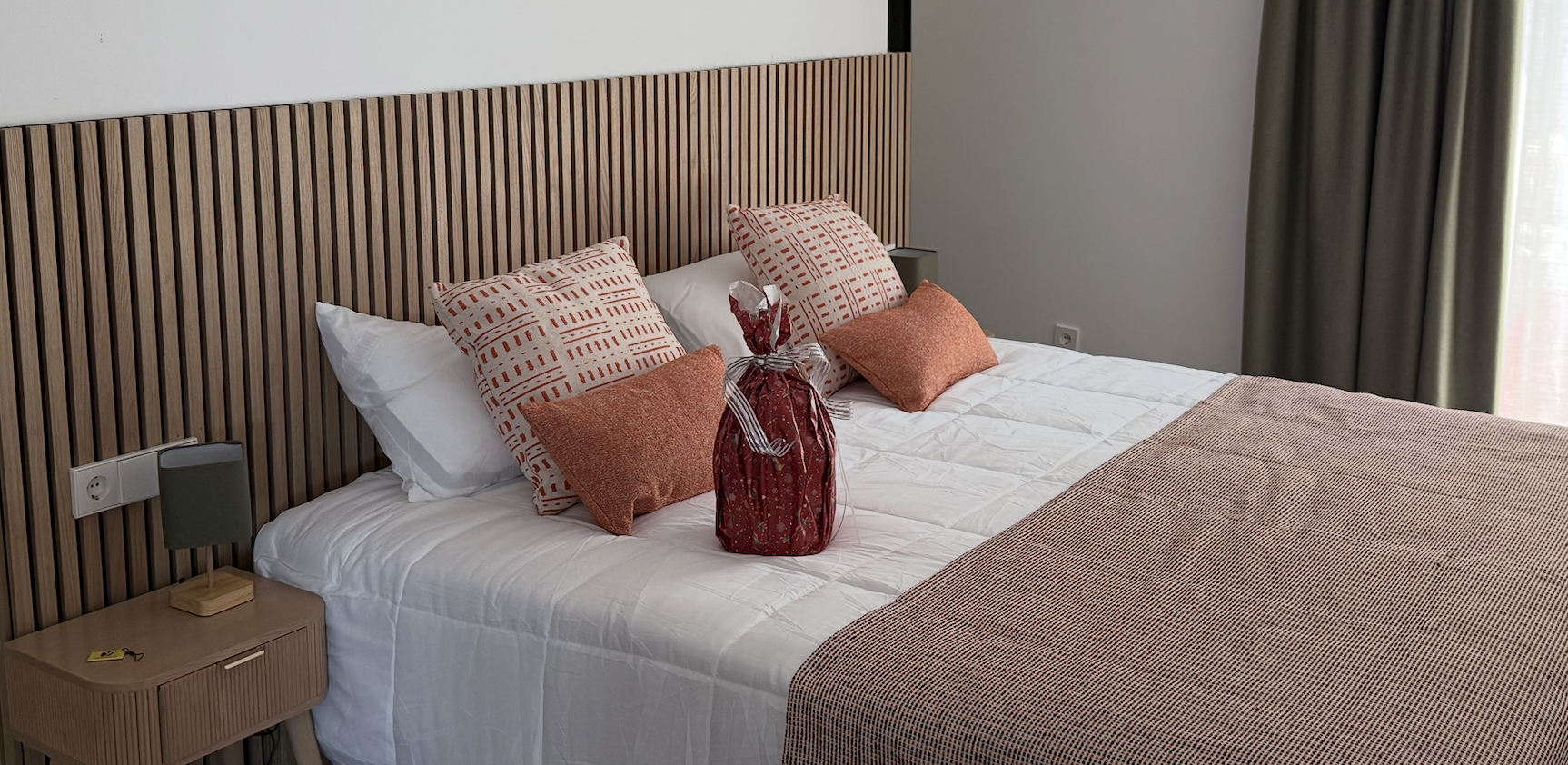
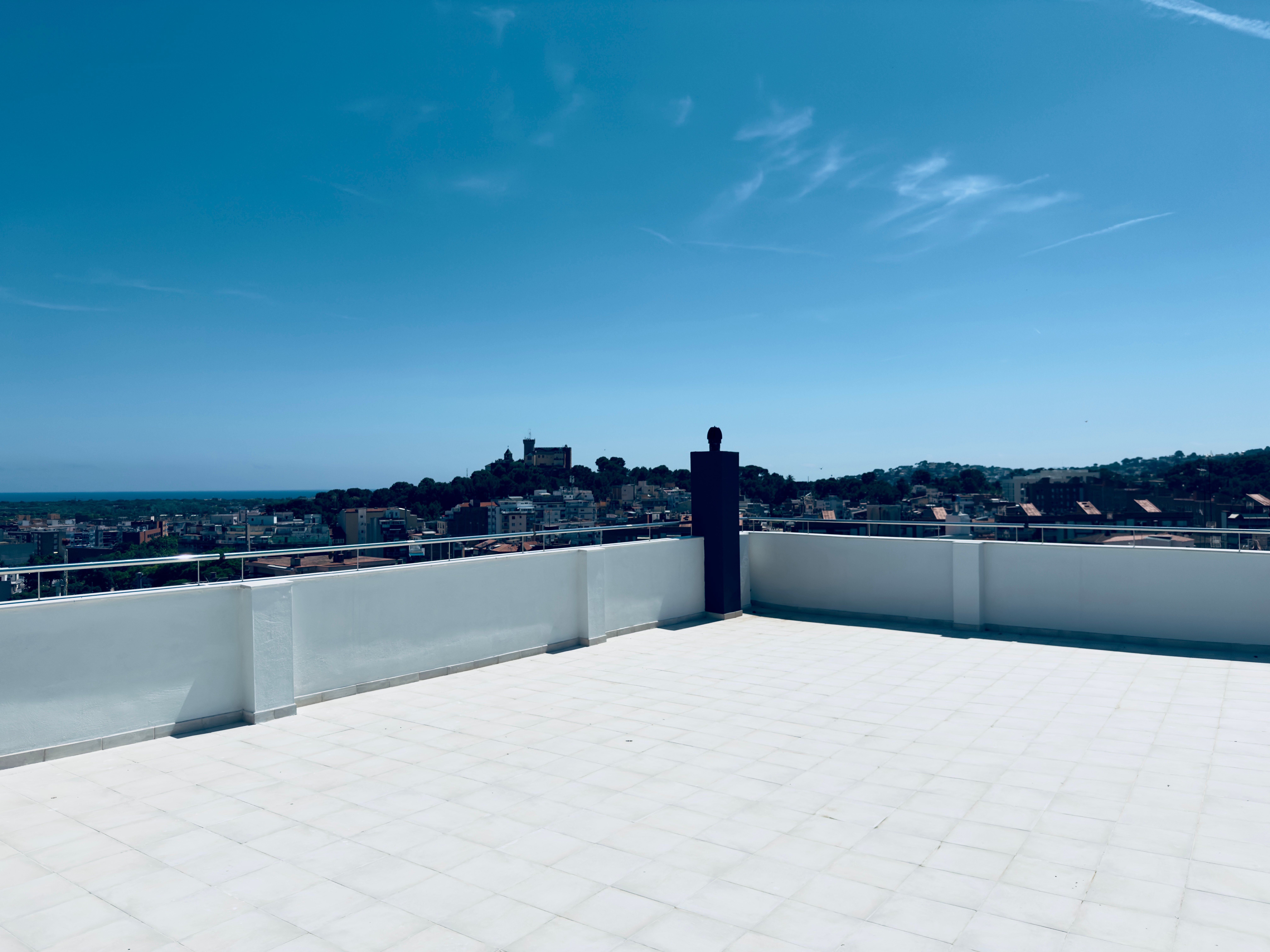
Green Living’s official page describes private rooms, including single, double, suite and loft options, furnished with eco-friendly materials, premium mattresses, desks and optional 4K monitors. It also lists high-speed Starlink internet, dedicated coworking spaces, two shared kitchens, laundry, cinema zone, private gym, rooftop with castle and sea views, outdoor jacuzzi, BBQ terrace and smart access.
Location
Castelldefels, Metropolitan Barcelona. Best if you want beach access, more space and a calmer base while staying connected to the city.
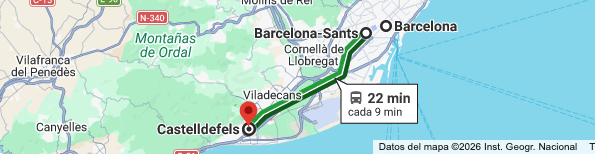
Not sure whether Castelldefels or central Barcelona fits you better? This guide explains why Castelldefels is becoming a hotspot for remote workers.
Rooms
Private rooms with desks and ergonomic chairs, with different room types available depending on budget and privacy needs.
Coworking
This is one of Green Living’s strongest areas. It is designed for people who work remotely every day, not just people who answer emails occasionally.
If your main priority is working comfortably every day, this guide to choosing a coliving with a good coworking space in Barcelona will help you evaluate the details before booking.

Community
The better way to describe the community promise is not “curated community”. It is lighter than that: shared kitchens, terraces, informal routines and a simple weekly activity plan. The goal is to create the conditions for natural connection, not force people into constant socialising.
Services
High-speed Starlink internet, coworking, shared kitchens, laundry, gym, terraces, rooftop, outdoor jacuzzi, BBQ terrace and smart access.
Pros
Strong remote-work setup, beach lifestyle, sustainability positioning, more space than many central city options, good fit for longer remote-work routines.

Cons
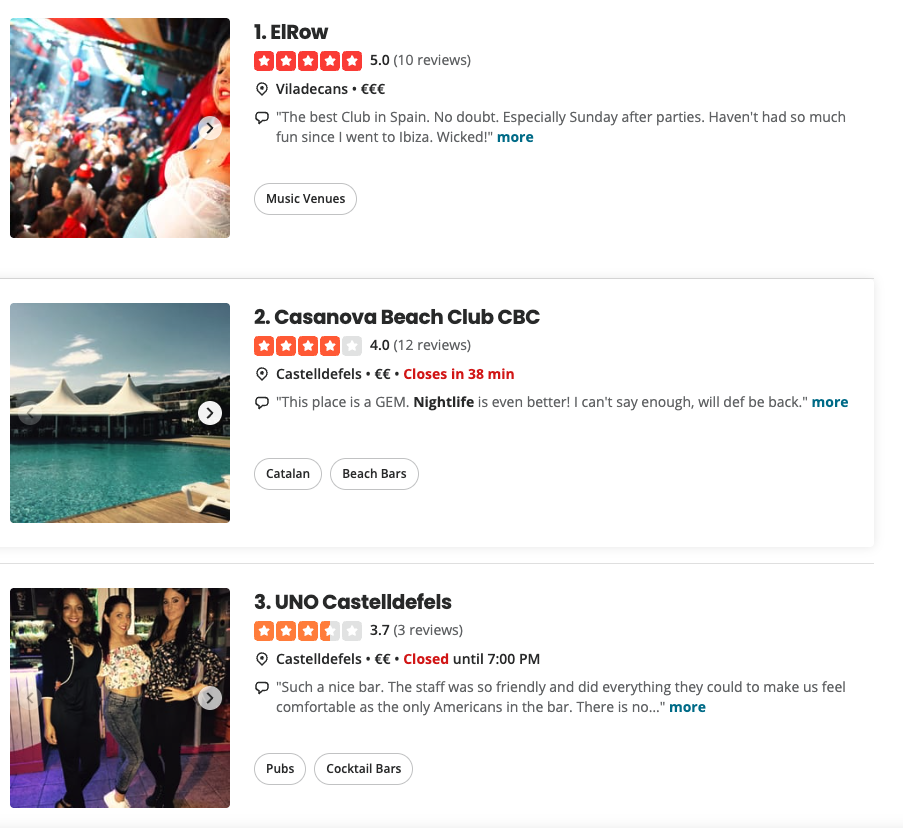
Best for beach lifestyle and work-life balance, not for those who need central Barcelona on their doorstep. Still, Playafels offers a lively beachfront scene with beach bars, clubs and nightlife, especially in summer.
Best for
Remote workers, founders, freelancers and professionals who want Barcelona access without central Barcelona intensity.
Estimated price
Check live availability and the specific room type before booking. Premium coliving prices in Barcelona vary widely depending on room size, bathroom type, included services and season. As a general reference, individual rooms with a shared bathroom can start from around €900 per month.
Where Green Living fits
Green Living is not the obvious choice if your priority is being in the centre of Barcelona every night. It is also not trying to be the cheapest option or the biggest social community in the city.
Its strength is different.
Green Living works best for remote workers, founders and professionals who want a quieter base near Barcelona, with more space, a stronger work setup, access to nature and a more intentional lifestyle. The point is not to escape Barcelona. The point is to experience Barcelona differently: with the city close enough to enjoy, but not so close that it takes over your daily routine.
That is why Castelldefels matters in this comparison. For some people, being outside the centre is a disadvantage. For others, especially those working remotely full time, it is exactly what makes the stay sustainable after the first two exciting weeks.
If your ideal Barcelona stay is built around nightlife, dense city energy and spontaneous plans every evening, Green Living may not be your best fit. If your ideal stay includes focused work, beach walks, better sleep, shared spaces, sustainability and a calmer rhythm, it should be on your shortlist.
Which coliving is best for each profile?
Best for remote workers
Green Living and The Social Hub are the strongest fits if your work setup is the priority. Green Living is better if you want a calmer routine, beach access and dedicated coworking in Metropolitan Barcelona. The Social Hub is better if you want an urban hub with many facilities, coworking access and a large-scale environment.
Best for digital nomads
Outsite, CoImpact and Aticco Living are strong options. Outsite works well if you like global coliving brands. CoImpact suits social nomads who want central Barcelona. Aticco is a good fit if you want professional ecosystem and coworking access.
Best for startup founders and entrepreneurs
Aticco Living and Circles House stand out. Aticco gives access to a wider coworking and entrepreneurial network. Circles is more boutique and intentional, better for people who want a house environment built around entrepreneurs.
Best for couples
Episode Barcelona is probably the strongest option if couples want privacy and a serviced apartment feel. Green Living can also make sense if a suitable double room, suite or loft is available and the couple wants community plus beach lifestyle.
Best near the beach
Green Living is the strongest option for beach lifestyle because Castelldefels gives residents more space and direct access to a coastal routine. The Social Hub Poblenou is also a good urban-beach compromise, with Poblenou location and beach access.
If beach access is a deciding factor, start by comparing central beach areas with Castelldefels as a Greater Barcelona base.
Best sustainable coliving
Green Living is the clearest fit here because sustainability is part of its positioning, materials and building concept. Most other operators may include efficient services or shared resources, but sustainability is less central to their public identity.
Best budget option
CoImpact, Enso and Episode’s coliving rooms appear more accessible based on public “from” prices, depending on room type and availability. CoImpact may be better if you want social energy; Enso may be better if you want a simpler shared-apartment model; Episode may be interesting if you want flexible private-room living.
For a fuller cost breakdown, compare these options with our guide to Coliving Barcelona prices.
Best premium experience
The Social Hub, Episode and Green Living all compete in different ways. The Social Hub is premium through facilities and hotel-style infrastructure. Episode is premium through private serviced living. Green Living is premium through remote-work setup, beach access, sustainability and facilities such as gym, rooftop and jacuzzi.
Best for people who want community, but not party life
Green Living, Circles House and some Aticco Living setups are worth comparing. The key is to distinguish community from constant activity. A good coliving should let you meet people without making social life feel compulsory.
Best for stays of 1 to 3 months
Outsite, CoImpact, The Social Hub and Green Living can all make sense, depending on availability and stay conditions. For shorter stays, flexibility and ease of arrival matter more than perfect long-term optimisation.
Best for stays of 6 months or more
For longer stays, the question changes. You are no longer choosing a cool room. You are choosing a life setup. Green Living may work well if you want routine, work stability and beach access. Episode may fit if you want more privacy. Aticco can be strong if professional networking is part of your plan.
Comparison matrix
| Operator | Work setup | Community style | Privacy | Location style | Best reason to choose it | Main thing to check |
|---|---|---|---|---|---|---|
| Green Living | Dedicated remote-work setup | Natural, routine-based | Private rooms | Beach / Greater Barcelona | Work-life balance and sustainability | Whether Castelldefels fits your lifestyle |
| Aticco Living | Strong through Aticco coworking access | Professional and active | Depends on apartment | Central Barcelona | Network and coworking ecosystem | Specific apartment quietness and privacy |
| CoImpact | Shared workspaces | Very social | Private/shared rooms | Central Eixample | Social city experience | Meeting-room needs and noise tolerance |
| Outsite | Remote-work-friendly | Global nomad community | Depends on room | Central/waterfront access | Known international brand | Exact property and live pricing |
| The Social Hub | Strong coworking and workspace access | Large-scale hub | Hotel-style rooms | Poblenou | Facilities and convenience | Whether you want a hotel-hub feel |
| Circles House | Coliving and coworking concept | Boutique and entrepreneurial | Depends on house | Barcelona | Founder/innovator environment | Availability and exact amenities |
| Enso | Basic work-from-home setup | Apartment-based | Private rooms | City apartments | Accessible pricing | Workspace quality |
| Citizenelles | Wi-Fi and furnished rooms | Women-only | Private rooms | Central Barcelona | Safety and women-only environment | Workspace depth and room availability |
| Episode | Communal workspaces | Serviced-living community | High | Multiple areas | Privacy and serviced apartment feel | Price, unit type and minimum stay |
FAQs about the best coliving spaces in Barcelona
Which is the best coliving space in Barcelona?
There is no single best coliving space in Barcelona. Green Living is strong for remote workers, beach lifestyle and sustainability. Aticco Living is strong for central locations and coworking ecosystem. CoImpact is strong for social city stays. The Social Hub is strong for facilities and extended stay. The best choice depends on your profile.
Which coliving is best for remote workers?
Green Living, The Social Hub and Aticco Living are among the strongest options for remote workers, but for different reasons. Green Living focuses on remote-work routine and beach lifestyle; The Social Hub offers large-scale coworking and facilities; Aticco connects housing with a coworking network.
Which coliving has the best coworking?
Green Living is strong for dedicated coworking inside the coliving. Aticco Living is strong because of access to Aticco coworking spaces. The Social Hub is strong for coworking and workspace access in a larger hub model.
Which coliving is closest to the beach?
Green Living is strongest for a true beach lifestyle because it is located in Castelldefels. The Social Hub Poblenou also offers good beach access from within Barcelona city.
Which coliving is best for entrepreneurs?
Aticco Living and Circles House are strong choices for entrepreneurs. Aticco offers a broader coworking and startup ecosystem, while Circles is more boutique and intentionally focused on entrepreneurs and innovators.
Which coliving is best for students?
CoImpact, The Social Hub and Citizenelles Living may suit students depending on profile. CoImpact is social and central, The Social Hub combines student accommodation and extended stay, and Citizenelles is designed for women seeking women-only shared living.
Which coliving is best for couples?
Episode is strong for couples who want more privacy and serviced apartment-style living. Green Living may also suit couples if a double room, suite or loft is available.
Which coliving is best for sustainability?
Green Living is the clearest fit for sustainable coliving because sustainability is central to its public positioning, materials and building concept.
Which coliving is best for budget-conscious residents?
CoImpact, Enso and some Episode coliving rooms show accessible public starting prices, depending on room type and availability. Always compare what is included, not only the monthly number.
Which coliving is best for long stays?
Green Living, The Social Hub, Aticco Living and Episode can all work for longer stays, but the best choice depends on whether you want shared living, hotel-style extended stay, coworking ecosystem or private serviced accommodation.
Is coliving in Barcelona cheaper than renting a flat?
Not always. Coliving may look more expensive than a room rental, but it often includes utilities, furniture, internet, cleaning, coworking or community. Renting a flat may be cheaper or more expensive depending on deposit, bills, furniture and contract conditions.
Is central Barcelona the best place for coliving?
Central Barcelona is best if you want nightlife, cafés, transport and city energy. It is not always best if you work from home full time and need quiet, space or beach access. Greater Barcelona areas such as Castelldefels can be better for routine and wellbeing.
Is Castelldefels too far from Barcelona?
Not for everyone. Castelldefels works well if you think in terms of Greater Barcelona and do not need to be in the centre several times a day. It gives more beach access, calm and space while remaining connected to Barcelona.
How should I compare coliving prices?
Compare the full monthly setup: rent, utilities, Wi-Fi, cleaning, coworking, furniture, deposit, minimum stay and flexibility. A cheaper room can become expensive if you need to pay separately for coworking or deal with poor work conditions.
What should remote workers check before booking?
Remote workers should check internet reliability, desk quality, call areas, noise levels, natural light, coworking access, room privacy and whether the space is actually designed for full-time work.
Are coliving spaces in Barcelona good for privacy?
Some are. Privacy depends on room type, bathroom setup, number of residents, house rules and common-area design. If privacy matters, avoid shared rooms and check whether the space has quiet zones.
Do coliving spaces in Barcelona include cleaning?
Many include cleaning of common areas, but private room cleaning varies. Always check what is included before comparing prices.
Can I register my address in a coliving?
It depends on the operator, contract type and legal structure. If address registration is important for visa, banking or local paperwork, ask before booking and get the answer in writing.
Is coliving better than Airbnb in Barcelona?
For stays longer than a few weeks, coliving is often better because it is more work-ready, community-oriented and designed for medium stays. Airbnb may still be useful for very short stays or a first trial week.
Should I book coliving before visiting Barcelona?
If you are arriving from abroad and need a ready-to-live setup, booking before arrival can make sense. If you are unsure, choose a flexible stay first and use it as a base while you compare neighbourhoods.
Final recommendation: which one should you choose?

It depends on what you are looking for. That sounds like a cautious answer, but in this case it is the honest one.
If your priority is remote work, beach access, sustainability and a calmer routine, Green Living is one of the strongest fits. If you want central Barcelona and a professional coworking ecosystem, Aticco Living may make more sense. If you want a social Eixample experience, look at CoImpact. If you want a global digital nomad brand, Outsite is worth comparing. If you prefer hotel-style extended stay with many facilities, The Social Hub is strong. If you want privacy and serviced living, Episode may be closer to what you need. If safety in a women-only environment is the priority, Citizenelles has a clear niche.
The main mistake is choosing based on photos alone. A beautiful room does not guarantee a good month. Look at your real week: calls, sleep, cooking, social life, transport, focus, exercise, budget and the amount of noise you can tolerate before becoming unpleasant to yourself and others.
Start with the fit, not the brand.
If you want the broader context before deciding, read the full guide to coliving in Barcelona. For cost planning, check Coliving Barcelona Prices and Cost of Living in Barcelona for Remote Workers. If your main concern is workspace, use How to Choose a Coliving with a Good Coworking Space in Barcelona. And if you are still comparing locations, read Best Areas to Live in Barcelona for Remote Workers and Why Castelldefels Is Becoming a Hotspot for Remote Workers.
For visa planning, see the Spain Digital Nomad Visa Guide. And if you are still wondering whether a normal room would be enough, read Renting a Room in Barcelona.
Choosing well is not about finding the “perfect” coliving. It is about finding the one whose trade-offs you can live with. That is usually where the right decision starts to become obvious.
Comments