
You arrive in Barcelona with a suitcase, a laptop and a very optimistic idea of how easy everything will be. The city looks simple from the outside. Beach in the morning. Work calls from a sunny desk. Dinner with interesting people. Maybe a weekend hike, maybe a rooftop drink, maybe that feeling that life has finally become a little less grey.
Then the practical questions begin.
Where do you actually live? Is it better to rent a room, book an Airbnb, find a flat or choose a coliving? How much should you expect to pay? Which neighbourhood makes sense if you work remotely? And, maybe the most underrated question of all: will your home make your workday easier, or will it slowly turn into another problem to manage?
That is where coliving in Barcelona becomes interesting. Not as a trendy word. Not as a magic solution. But as a very practical answer for people who need a place to live, work, meet others and settle into the city without spending their first month fighting with paperwork, furniture, Wi-Fi and loneliness.
This guide is written for remote workers, digital nomads, founders, freelancers, international students and professionals relocating to Barcelona. It is also written with one simple idea in mind: by the end, you should understand whether coliving is right for you, where to look, what it really costs and what to avoid.
Quick answer: is coliving in Barcelona worth it?
Coliving in Barcelona is worth it if you want flexible accommodation, reliable internet, shared spaces, community and a smoother landing in the city. It is especially useful for remote workers, digital nomads, founders and professionals staying from one to nine months. It is not always cheaper than renting a room, but it often includes utilities, furniture, cleaning, coworking areas and social infrastructure. Renting a flat may be better for long-term residents who want full privacy and already understand the local market. For many newcomers, coliving is the easiest first base before deciding where and how to live in Barcelona.
Table of contents
- Why trust this guide?
- What is coliving?
- The Green Living Framework
- What we have learned from hosting remote workers
- Why Barcelona works so well for remote workers
- Who is coliving for?
- Who should not choose coliving?
- Coliving vs apartment, Airbnb, hotel and shared flat
- How much does coliving cost in Barcelona?
- Best areas for coliving in Barcelona
- Coworking and remote work setup
- Community: what actually happens in a good coliving?
- Sustainable coliving in Barcelona
- A typical day in a Barcelona coliving
- The resident journey
- Your first month in Barcelona: a realistic timeline
- Checklist before booking
- FAQs about coliving in Barcelona
- Conclusion
Why trust this guide?

Most articles about coliving in Barcelona are written from a distance. They list neighbourhoods, add a few prices, mention digital nomads and move on. Useful, maybe. But not enough if you are actually about to choose where to live.
Green Living works inside this market. Not as a directory, but as an operator building and managing flexible living spaces for people who live, work and build routines in Barcelona. That gives us a different kind of perspective: the practical one. The one that notices when a room has a desk but no real place to take calls. The one that understands that “community” means nothing if people cannot also be alone. The one that knows Wi-Fi is not an amenity when your job depends on it.
Our Barcelona coliving is located in Castelldefels, in Metropolitan Barcelona, and includes private rooms, desks, optional 4K monitors, high-speed Starlink internet, dedicated coworking areas, shared kitchens, gym, terraces and a simple weekly activity plan. It is designed around people who are not just travelling through the city, but trying to live properly while working remotely.
This guide is not here to say that Green Living is the only good option. That would be suspicious, frankly. The goal is to help you compare coliving with other housing options, understand the trade-offs and make a decision you will not regret after two weeks.
What is coliving?
Coliving is a modern housing model where residents have private rooms and share common spaces such as kitchens, lounges, terraces, coworking areas or gyms. The idea is not just to share rent. It is to share infrastructure, services and a certain kind of daily life.
In Barcelona, a proper coliving usually includes furniture, utilities, internet, cleaning of common areas and access to social or professional spaces. Some places are more focused on students. Others are designed for digital nomads, startup people or remote professionals. Some are beautiful but chaotic. Some are functional but cold. The label alone does not tell you enough.
The important thing is this: coliving is not the same as renting a room in a shared flat. In a shared flat, you are usually joining an existing apartment. The experience depends heavily on the landlord, the flatmates, the building and luck. In coliving, the space is supposed to be designed and managed around shared living from the beginning.
| Housing model | What it usually means | Best for |
|---|---|---|
| Coliving | Private room, shared spaces, services included, community and often coworking | Remote workers, newcomers, flexible stays |
| Shared flat | Room in an apartment with flatmates, usually fewer services | Lower budgets, students, people staying longer |
| Private apartment | Your own flat, full control, more admin | Long-term residents, couples, families |
| Airbnb | Short-term furnished stay, flexible but often expensive | Short stays, trial periods, holidays |
| Hotel | Serviced room, no home feeling | Business trips, very short stays |
The best way to think about coliving is simple. Renting gives you a place. Coliving should give you a setup.
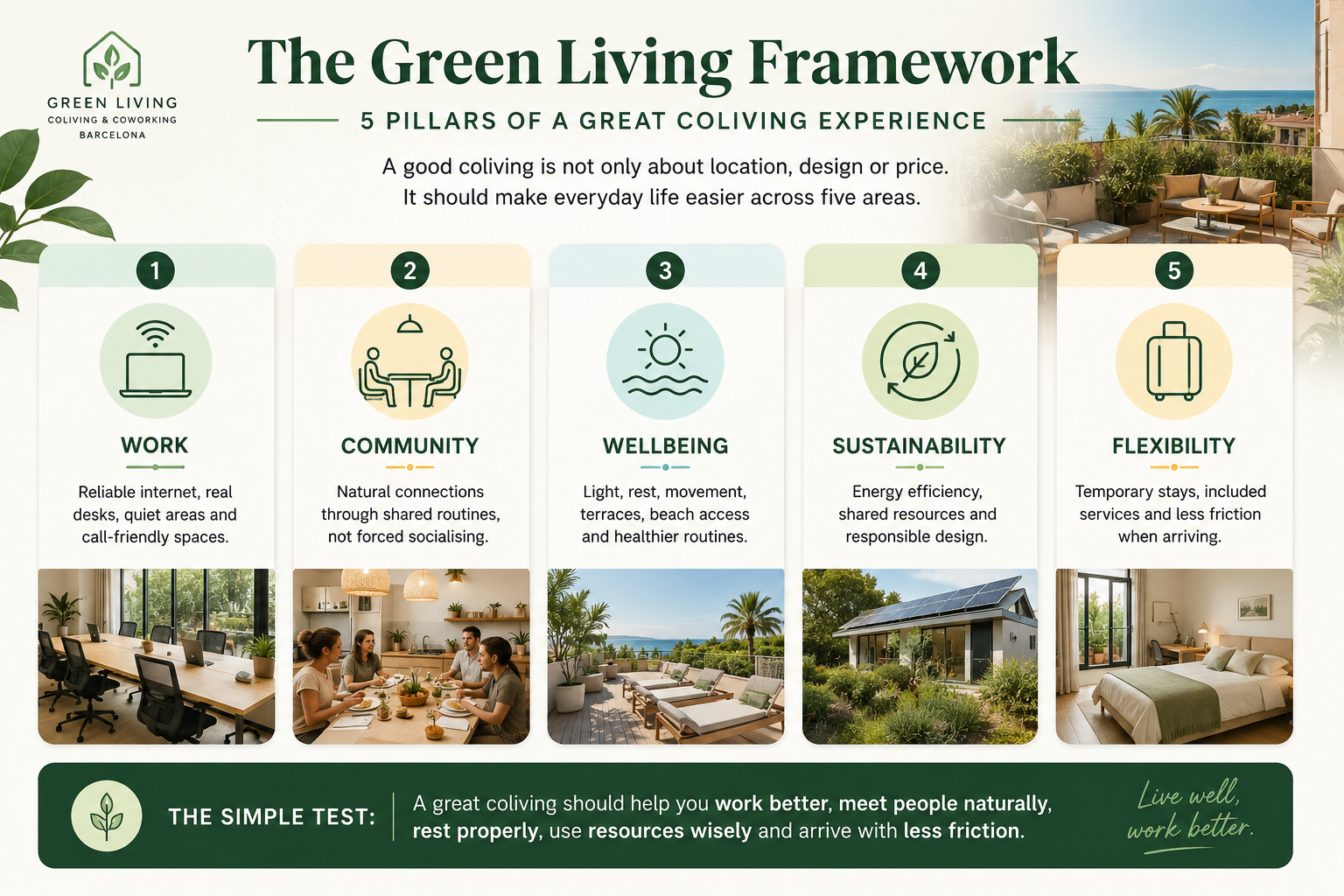
The Green Living Framework: 5 pillars of a great coliving
After looking closely at how people actually live in shared spaces, we do not think a good coliving can be judged only by location, design or price. Those things matter, obviously. But they are not enough.
At Green Living, we use five pillars to evaluate whether a coliving experience really works. You can use them too, even if you never stay with us. Actually, that is the point. A useful framework should help you choose better anywhere.
| Pillar | What it means | What to look for |
|---|---|---|
| Work | The space must support real remote work, not just occasional laptop use. | Reliable internet, proper desks, quiet areas, call-friendly spaces and enough plugs. |
| Community | People should connect naturally, without being forced into constant socialising. | Shared kitchens, terraces, optional weekly activities, informal routines and freedom to opt out. |
| Wellbeing | The building should help residents rest, move and keep a healthy routine. | Natural light, good beds, outdoor space, gym or movement areas, beach and nature nearby. |
| Sustainability | The model should reduce waste and use resources more intelligently. | Energy efficiency, shared infrastructure, responsible materials and thoughtful renovation. |
| Flexibility | The stay should be easy to start, extend or adapt without unnecessary friction. | Temporary stays, included services, clear terms and a smoother arrival process. |
A weak coliving usually fails in one of these areas. It may look beautiful, but have no real workspace. It may have social areas, but no privacy. It may call itself sustainable, but show no evidence beyond a few plants and some recycled language. Or it may be flexible in theory, but full of unclear conditions once you try to book.
A great coliving is not perfect. Nothing shared is perfect. But it should make your week easier in all five areas: work, community, wellbeing, sustainability and flexibility.
What we have learned from hosting remote workers
Some things only become obvious when you see people actually living in the space. Not visiting. Not taking photos. Living. Working. Cooking. Getting tired. Making friends. Changing plans.
One thing we have learned is that residents care about Wi-Fi most when it fails. Nobody books a room because of a router. But if the connection drops during a client call, suddenly the whole experience feels fragile. For remote workers, reliability is not a luxury. It is peace of mind.
We have also learned that community works better when participation is easy but never forced. People like knowing there is a dinner, a terrace conversation or a shared plan available. They do not like feeling guilty for choosing a quiet night. Good community has doors, not walls. You can enter, leave and come back without drama.
Another lesson: many people arrive thinking location is everything. Then, after a few weeks, they discover that routine matters more. Being five minutes closer to the centre is less useful if you sleep badly, work from a bad chair or feel drained every evening. A good day is built from boring things: light, silence, a real kitchen, a desk, clean common areas and someone nearby when you feel like talking.
We have seen residents arrive planning to stay for one month and then extend because their routine finally works. Calls in the morning. Training after work. Dinner with people they did not know two weeks earlier. Barcelona close enough, but not overwhelming every night. Nothing dramatic. Just a week that starts to hold together.
That is hard to show in a booking engine. But it is exactly what people remember.
Operational lessons we would use to judge any coliving
- Residents notice Wi-Fi only when it fails, so reliability matters more than speed claims.
- A good desk, a quiet call area and a real kitchen often matter more than a decorative lounge.
- Community is stronger when it grows from routines, not from forced activities.
- Privacy is not the opposite of community; it is what makes community sustainable.
- Location matters, but daily rhythm decides whether people extend or leave.
Why Barcelona works so well for remote workers
Barcelona has become one of Europe’s most attractive cities for people who can work from anywhere. The reasons are obvious at first: Mediterranean climate, beach, food, international community and a city size that feels manageable compared with London, Paris or Berlin.
But the deeper reason is that Barcelona works as a professional base. Barcelona Activa works to generate, develop and attract talent to the city, offering advice, training, support and networking for professionals, entrepreneurs and companies. That kind of infrastructure matters when you are not just visiting, but trying to build a life or a business here.
The remote-work signal is also strong. Catalan News reported that more than 30% of Spain’s remote-work residency permits granted in 2024 were issued for settlements in the Barcelona area, with 6,401 requested for Barcelona compared with 3,514 for Madrid. That does not mean Barcelona is perfect. It means many people with options are choosing it anyway.
Then there is the startup ecosystem. Poblenou’s 22@ district is one of the city’s strongest symbols of this shift. 22@ Network describes the area as a district that has reached important benchmarks in innovation, economic development and positioning within Barcelona. Translated into normal life: you will find founders, product people, designers, events, meetups and a lot of people opening laptops in places that used to be factories.
Barcelona also has something many larger cities lack: you can work seriously and still have the sea nearby. That matters. A walk after a long call is not a productivity hack. It is just human maintenance.
What makes Barcelona especially attractive?
| Factor | Why it matters for remote workers |
|---|---|
| Climate | Outdoor life is easier for much of the year, which helps balance screen-heavy work. |
| International community | It is easier to meet people who are also new, mobile or professionally independent. |
| Startup ecosystem | Useful for founders, freelancers, tech workers and people looking for events or contacts. |
| Transport | The city and metropolitan area are relatively easy to move around compared with bigger capitals. |
| Beach and nature | Recovery after work is part of the lifestyle, not a weekend-only privilege. |
| Greater Barcelona | Remote workers can choose central areas or calmer metropolitan bases such as Castelldefels. |
Who is coliving for?
Coliving is not for everyone. That is exactly why it works when it works. The people who enjoy it are usually not looking only for a bed. They are looking for a smoother way to enter a city, work properly and avoid the loneliness that sometimes comes with flexibility.
Remote workers
If you work from your laptop, the quality of your home environment matters. A room without a desk is not charming after the third call from bed. Remote workers benefit from coliving when the space includes reliable internet, work areas, quiet corners and people who understand that weekdays are not holidays.
Digital nomads
Digital nomads often need flexibility, community and a place that works immediately. Coliving can solve the first annoying layer of relocation: Wi-Fi, furniture, bills, finding people and figuring out where to work.
Startup founders
Founders tend to blur work and life anyway. A good coliving can support that without making everything feel chaotic. The useful part is not just networking; it is being around people who understand uncertain schedules, intense weeks and conversations that start with “I’m testing an idea”.
Freelancers
Freelancers need focus, but they also need not to disappear into their own heads for days. Coliving can offer light social contact without forcing an office routine.
Professionals relocating to Barcelona
If you are moving for work, coliving can be a first base while you understand the city. You can test neighbourhoods, learn transport, open accounts, deal with paperwork and decide later whether renting a flat makes sense.
International students
Students can benefit from coliving when they want something more structured than a random shared flat, especially if they value community, study space and flexible stays.
Who should not choose coliving?
This section matters. Any guide that says coliving is right for everyone is trying too hard.
You should probably not choose coliving if you need full privacy all the time. Yes, you may have your own room. Maybe even your own bathroom. But kitchens, terraces, lounges and coworking areas are shared. If the idea of seeing people before breakfast already irritates you, listen to that feeling.
You may also prefer renting if you are moving as a couple and want a long-term home, or if you have pets, a family routine, a lot of belongings or very specific domestic habits. Coliving is flexible, but it is not infinitely adaptable.
It may not be the best choice if your budget is extremely tight. A basic room in a shared flat can be cheaper. Not always better, but cheaper. If your only priority is the lowest monthly number, coliving may feel expensive because it bundles services you may not value yet.
And finally, avoid coliving if you dislike shared norms. In a good coliving, there are rules. Quiet hours, cleaning expectations, guest policies, activity guidelines, booking systems. These things are not there to ruin freedom. They are there because adults sharing space without structure eventually becomes a documentary nobody wants to star in.
Coliving vs apartment, Airbnb, hotel and shared flat
Most people do not compare coliving in isolation. They compare it with other ways of staying in Barcelona. That is the right approach.
The mistake is comparing only the monthly price. A flat may look cheaper until you add deposit, bills, furniture, internet, cleaning and a coworking membership. Airbnb may look easier until you realise the price is high and the experience can feel strangely lonely. A hotel may work for five nights. For five weeks, it can start to feel like living inside a corridor.
| Option | Strength | Weakness | Best use case |
|---|---|---|---|
| Coliving | Flexible, social, furnished, services included, often work-ready | Less privacy than a flat, quality varies | Remote workers staying 1–9 months |
| Private apartment | Full privacy and control | Paperwork, deposits, bills, furniture, longer commitment | Long-term residents who know the city |
| Airbnb | Easy to book, flexible for short stays | Often expensive, limited community, regulatory pressure | First days or very short trials |
| Hotel | Convenient and serviced | No kitchen, no community, expensive for long stays | Business trips or short stays |
| Shared flat | Can be cheaper | Unpredictable flatmates, weaker work setup, hidden frictions | Students or low-budget longer stays |
Barcelona’s housing context also matters. The city has announced plans to phase out short-term tourist apartment rentals by November 2028, a measure reported by Reuters as part of a wider attempt to curb rising housing costs and improve livability for residents. That does not mean Airbnb disappears tomorrow, but it does show why long-stay housing is becoming a more serious conversation.
If you want to go deeper into one specific comparison, read our guide to coliving vs renting a flat in Barcelona.
How much does coliving cost in Barcelona?
Let’s talk about money, because pretending it is not important would be ridiculous.
According to Catalan News, the average rent price in Barcelona reached €1,160.99 per month in the fourth quarter of 2025, based on INCASÒL rental bond data. That figure is useful as context, but it does not tell the full story. It does not include whether the place is furnished, whether bills are included, whether you can work comfortably or how much deposit and paperwork are required.
For coliving, realistic prices vary depending on location, room type, services and whether the space is actually designed for remote work. Based on Green Living’s own market guide, current Barcelona coliving ranges look roughly like this: private rooms around €900–€1,200, double rooms around €1,400–€1,600, and suites with private bathrooms around €1,800–€2,200 or more.
| Accommodation type | Typical monthly range | What to check |
|---|---|---|
| Shared room or basic room | €500–€900 | Utilities, flatmates, work setup, contract conditions |
| Private coliving room | €900–€1,200 | Internet, cleaning, coworking, community, room size |
| Premium coliving room or suite | €1,400–€2,200+ | Private bathroom, desk, monitor, amenities, location |
| Airbnb long stay | €1,200–€2,000+ | Fees, legality, isolation, kitchen and work setup |
| Hotel long stay | €2,000–€3,500+ | Kitchen access, laundry, comfort for long stays |
| Private apartment | €1,160+ average, often more in practice | Deposit, furniture, bills, documents, agency conditions |
The key is to compare full setups, not labels. A €750 room with weak Wi-Fi, noisy flatmates and no desk can become expensive in a very quiet way. A €1,100 coliving room with utilities, coworking and cleaning included may be better value if it lets you actually live and work properly.
For a deeper breakdown, read Coliving Barcelona prices: what it really costs.
Best areas for coliving in Barcelona
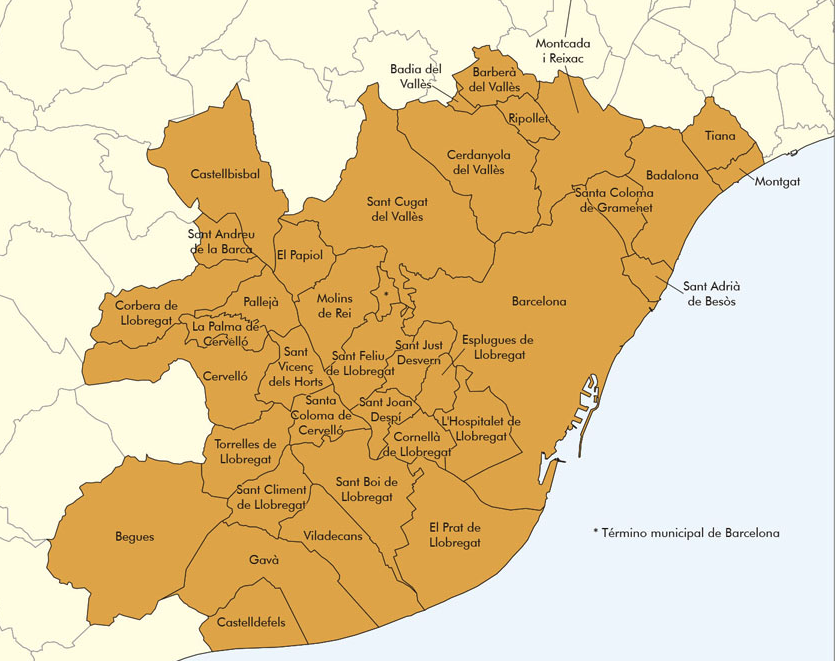
Many newcomers make the same mistake: they think living in Barcelona must mean living as close as possible to the centre. Plaça Catalunya becomes the imaginary sun, and everything else starts orbiting around it.
But that is not how large cities work. If you have lived in London, you understand this immediately. Someone can live in Wimbledon and still have a normal London life, even if Oxford Street is not around the corner. Barcelona works on a smaller, easier scale. Greater Barcelona gives you options: central energy when you want it, calmer bases when you need them.
Here is the short version.
| Area | Best for | Potential downside |
|---|---|---|
| Poblenou | Startup energy, beach access, coworking | Popular and increasingly expensive |
| Gràcia | Local life, cafés, creative rhythm | Older flats, noise around squares |
| Eixample | Convenience, transport, central comfort | Traffic noise and higher prices |
| Sant Antoni | Central life with a local edge | Still busy and urban |
| Barceloneta | Beach-first lifestyle | Small apartments, tourism, noise |
| Castelldefels | Beach, space, calmer rhythm, Greater Barcelona access | Less nightlife on your doorstep |
Castelldefels deserves special attention for remote workers. TMB lists Castelldefels in fare zone 1, which makes the connection with Barcelona more practical than many newcomers expect. It is not “far away” in the dramatic sense. It is a metropolitan base with more sea, more space and less daily pressure.
That is why Castelldefels is becoming a hotspot for remote workers. It gives you access to the Barcelona ecosystem without requiring you to sleep in the busiest part of the city every night.
For the full neighbourhood breakdown, read Best Areas to Live in Barcelona for Remote Workers.
Coworking and remote work setup
A coliving without a proper work setup is just a shared house with better branding.
This is where many people get caught. They see “coworking included” and assume everything is fine. Then they arrive and discover the coworking space is a dining table, the chair is decorative, the Wi-Fi collapses during calls and the only quiet spot is the bedroom. At that point, the word coworking starts to feel very generous.
A good coworking coliving in Barcelona should have more than a table. It should offer stable internet, comfortable desks, enough plugs, natural light, quiet areas and a sensible way to handle calls. If several residents work remotely, the space needs to be designed for that reality.
| Feature | Why it matters |
|---|---|
| Reliable internet | Your work should not depend on luck. |
| Proper desks and chairs | Your body notices bad ergonomics quickly. |
| Call-friendly areas | Remote work is talking as much as typing. |
| Quiet hours | Shared living needs boundaries to work. |
| Enough seats | A coworking space should fit real occupancy, not just photos. |
| Separation from kitchen/social zones | Lunch noise and client calls are not natural partners. |
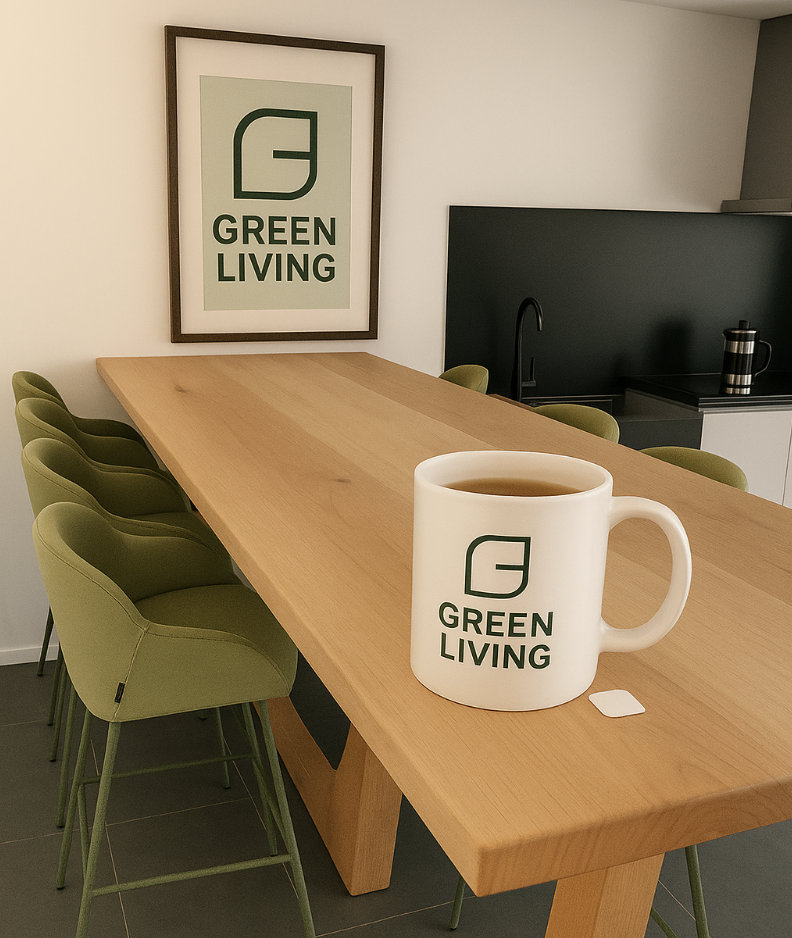
Green Living’s Barcelona space includes dedicated coworking areas, high-speed Starlink internet, private rooms with desks, optional 4K monitors, shared kitchens, gym, terraces and a simple weekly activity plan. That combination is important because many residents are not working “sometimes”. They are working every day.
Before you book, compare the routine, not only the room
If your priority is not just visiting Barcelona but building a stable work-life routine here, compare room types, work setup, location and included services before booking. Green Living is designed for people who need Barcelona to work as a home, not only as a destination.
Before booking any space, ask one simple question: could I work here comfortably for a full week? If the honest answer is no, keep looking.
For a deeper checklist, read How to Choose a Coliving with a Good Coworking Space in Barcelona.
Community: what actually happens in a good coliving?

Community is the most overused word in coliving. It is also one of the most important parts when done properly.
A good community is not forced fun. It is not mandatory dinners, motivational posters or a group chat that never sleeps. It is something quieter and more useful: familiar faces, easy conversations, shared routines, people to ask for advice and the feeling that you are not starting from zero every day.
For remote workers, that matters more than expected. Remote work gives you freedom, yes. It can also make your days oddly silent. You close the laptop and suddenly realise you do not know who to text for dinner. You have flexibility, but no local rhythm yet.
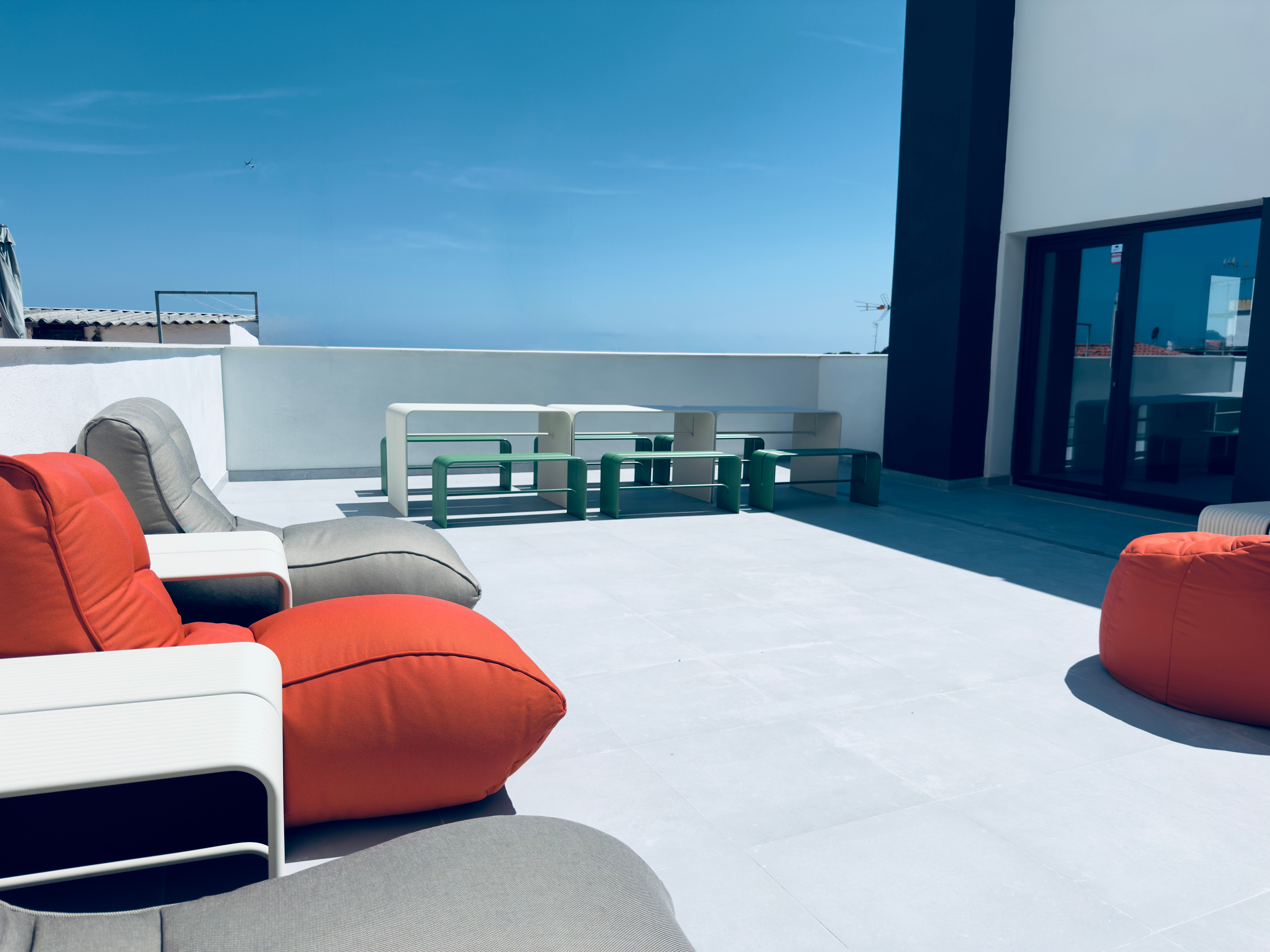
In a good coliving, connection happens through design and habits. Shared kitchens create casual contact. Coworking areas make people visible during the day. Terraces give residents a natural place to pause. Optional weekly activities help, but they should never feel like homework.
This is important: the goal is not to be surrounded all the time. That would be exhausting. The goal is to have enough social life available that you do not feel isolated, and enough privacy available that you do not feel trapped.
The best relationships in coliving usually do not begin at the “official event”. They begin while someone is making pasta, asking where to buy coffee, sharing a taxi to the airport, joining a beach walk or working quietly at the same table three mornings in a row. Repetition creates trust. Not in a loud way. Just slowly.
A small story, because this is how it usually works
Someone arrives on Monday. They are polite, tired and pretending they are less overwhelmed than they are. On Tuesday, they ask where to buy groceries. On Wednesday, someone mentions a plan for the weekend. By Friday, they know two people well enough to go for a walk after work. Not a movie scene. Just enough to make the city feel less anonymous.
That is the real value of coliving community. Not instant best friends. Just a softer landing. And, ideally, the freedom to be social today and invisible tomorrow without anyone making it weird.
Sustainable coliving in Barcelona

Sustainability in housing has a problem: everyone uses the word, but not everyone means much by it.
A few plants in the lobby are not sustainability. Recycled-looking furniture is not enough either. In coliving, sustainability should be practical. It should appear in how the building uses energy, how resources are shared, how spaces are designed, how water and heating are managed, and how the model reduces waste compared with everyone duplicating everything in separate homes.
Green Living’s work in Castelldefels includes a stronger version of this idea. One of its articles describes the transformation of a former industrial bakery into an energy-autonomous coliving, using high-performance insulation, aerothermal systems, domotics, optimised water systems and cross ventilation. That is the kind of sustainability that belongs in the walls, not just in the copy.
The bigger point is not that every resident needs to become an energy expert. Nobody wants that after a long meeting. The point is that the space should help people live better with fewer wasted resources.
Sustainable coliving in Barcelona should mean:
- better use of existing buildings where possible;
- shared infrastructure instead of duplicated consumption;
- energy-efficient systems;
- durable materials;
- good ventilation and natural light;
- community habits that reduce waste;
- respect for the neighbourhood, not just the resident experience.
There is also an ethical side. Barcelona has real housing pressure. Any serious coliving project should recognise that, not pretend the city is just a playground for international workers. Responsible coliving has to be transparent, well managed and useful for the urban fabric around it.
A typical day in a Barcelona coliving
Let’s make this less abstract.
You wake up around 8:00. Maybe earlier if you work with another time zone, maybe later if your calendar allows it. You make coffee in the shared kitchen, still half asleep, and someone asks if you are going to the coworking space later. You say yes, because saying yes to small things is how a new city starts becoming yours.
At 9:00, you open your laptop. The internet works. That should not feel luxurious, but sometimes it does. You take one call from the coworking area and another from your room because it is more private. No drama. No searching for a café with plugs. No ordering a second coffee just to justify staying there.
Lunch is simple. Maybe you cook. Maybe you join someone going out. Maybe you eat leftovers and call it discipline. In the afternoon, you work again, but the day does not feel sealed inside four walls. There is a terrace. There is light. There are people around, but not too close.
After work, you go for a walk near the beach, train, join a dinner or do absolutely nothing. This last option is important. A good coliving gives you community, but it also lets you disappear without needing to explain yourself.
That is the rhythm people are usually looking for, even if they describe it with different words. Work that works. People nearby. A city outside. A home that does not require constant management.
The resident journey: from arrival to routine
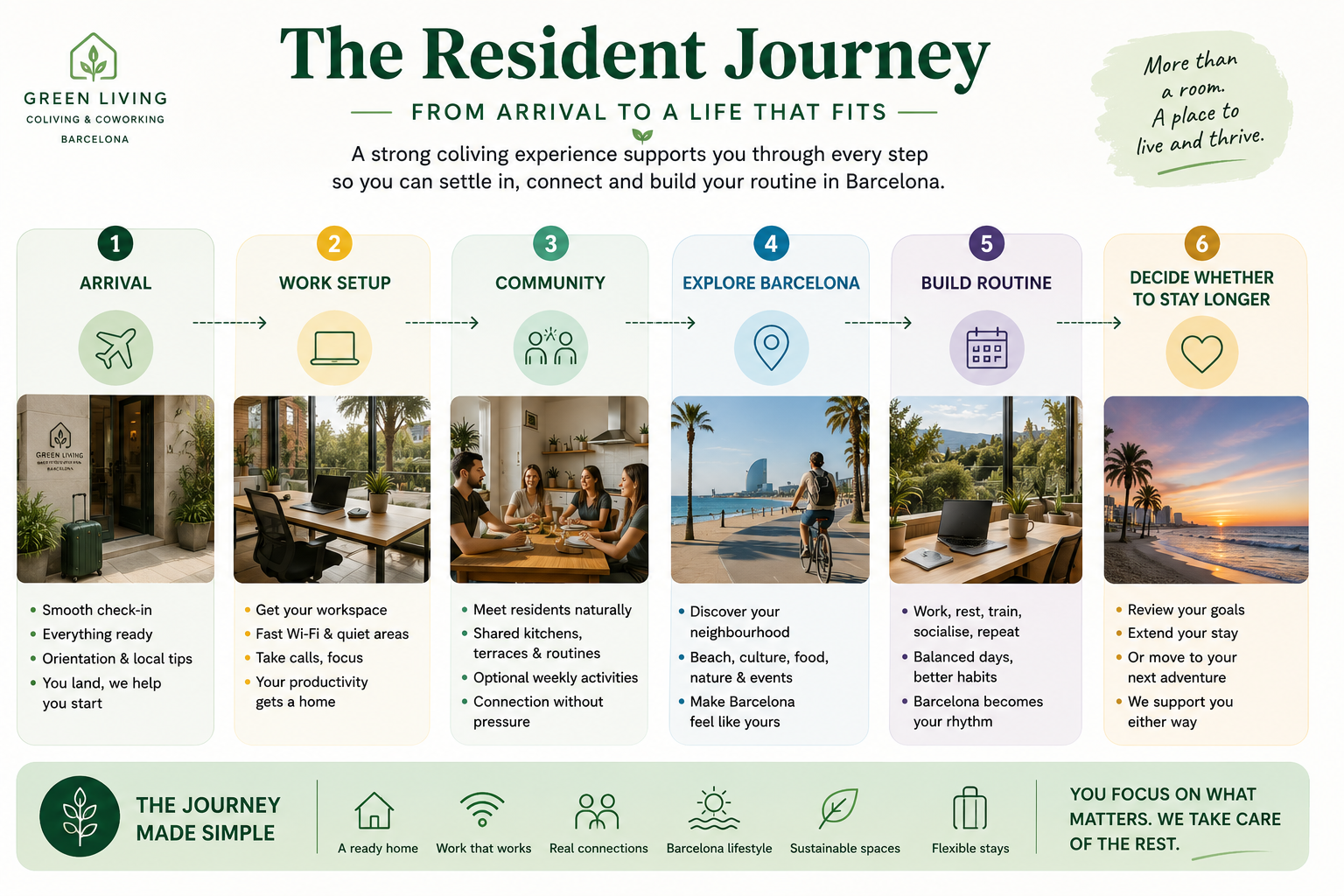
A strong coliving experience should help you move through a simple journey. Not a funnel. Not a sales process. A human one.
Arrival → Work setup → Community → Explore Barcelona → Build routine → Decide whether to stay longer
At first, you need practical things: keys, Wi-Fi, a room, a desk, a supermarket, a way to get around. Then you need rhythm: where to work, when to cook, who to talk to, how to rest. Then, only then, you can decide whether Barcelona is just a chapter or maybe a longer story.
This is one of the quiet strengths of coliving. It gives you enough structure to start living before you have everything figured out.
Your first month in Barcelona: a realistic timeline
The first month in Barcelona is rarely as smooth as Instagram suggests. It can be exciting, messy, beautiful and mildly confusing, all before lunch. A good coliving helps because it gives structure while the rest of your life catches up.
| Week | What usually happens | What helps |
|---|---|---|
| Week 1 | You arrive, unpack, learn the area, find supermarkets, test your work routine. | A ready room, working Wi-Fi, clear house rules, friendly orientation. |
| Week 2 | You start comparing neighbourhoods, cafés, gyms, transport and daily habits. | Local advice from residents and staff, flexible routines, easy mobility. |
| Week 3 | You begin to understand what you actually need: more quiet, more people, more beach, more city. | Community without pressure, spaces for work and rest. |
| Week 4 | You decide whether Barcelona is a short stay, a longer chapter or maybe something bigger. | Clear pricing, extension options, links to visa and housing information. |
If you are non-EU and planning to work remotely from Spain for longer, check the official digital nomad visa information. Spain’s consular guidance describes it as a visa for foreigners planning to live in Spain as residents while working remotely for a company or employer outside Spain, or working self-employed using computer and telecommunication systems.
For a practical overview, read Green Living’s guide to the Spain Digital Nomad Visa.
Checklist before booking a coliving in Barcelona
Before you book, slow down. Good photos are not enough. A beautiful terrace will not save you from weak Wi-Fi, bad sleep or a workspace that only works in theory.
| Question | Why it matters |
|---|---|
| Is the room private and properly furnished? | You need somewhere to rest, not just sleep. |
| Is there a real desk in the room or coworking area? | Remote work needs a physical setup. |
| Is internet speed clearly explained? | “Fast Wi-Fi” is not a technical answer. |
| Are utilities included? | This changes the real monthly cost. |
| Is cleaning included? | Shared spaces need structure. |
| Are calls easy to take? | Work privacy matters. |
| What kind of people usually stay there? | Community fit is real. |
| How long do residents stay? | A revolving door feels different from a stable house. |
| Where is it located? | Daily rhythm matters more than the map suggests. |
| What is the cancellation or extension policy? | Flexibility only helps if the terms are clear. |
If you are still considering a normal room instead, read Renting a room in Barcelona: what no one really tells you. It helps you compare the everyday friction, not just the price.
FAQs about coliving in Barcelona

What is coliving in Barcelona?
Coliving in Barcelona usually means renting a private room in a managed shared living space with common areas, services included and, in many cases, coworking facilities. It is designed for people who want flexibility, community and a ready-to-use home.
Is Barcelona a good city for remote workers?
Yes. Barcelona offers good weather, international community, beach access, startup activity, coworking spaces and strong appeal for remote professionals. The Barcelona area received more than 30% of Spain’s remote-work residency permit requests in 2024.
How much does coliving cost in Barcelona?
Realistic coliving prices in Barcelona often range from around €900 to €1,200 for a private room, €1,400 to €1,600 for a double room and €1,800 to €2,200 or more for suites with private bathrooms. Prices depend on location, services and room type.
Is coliving cheaper than renting?
Not always. Coliving can look more expensive than a basic room rental, but it often includes bills, furniture, internet, cleaning, coworking and community. Renting may be cheaper if you only compare rent, but not always if you compare the full setup.
Is coliving better than Airbnb in Barcelona?
For stays longer than a few weeks, coliving is often more practical than Airbnb because it is more community-oriented, more work-ready and usually designed for medium stays. Airbnb can still make sense for a very short trial period.
Is coliving better than renting a flat?
Coliving is usually better for newcomers, remote workers and people who want flexibility. Renting a flat is better for long-term residents who want full privacy, have local paperwork and are ready to manage bills, furniture and contracts.
Which area is best for coliving in Barcelona?
Poblenou is strong for startup energy and beach access. Gràcia is good for local life. Eixample is practical and central. Castelldefels is a strong Greater Barcelona option for remote workers who want more space, beach access and a calmer rhythm.
Is Castelldefels a good option for remote workers?

Yes. Castelldefels can work very well for remote workers who want access to Barcelona without living in the most intense central areas. TMB lists Castelldefels in fare zone 1, which helps keep it connected to the Barcelona transport system.
Is Castelldefels too far from Barcelona?
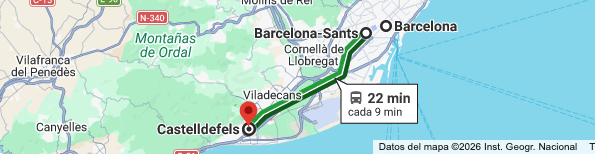
For many remote workers, no. Castelldefels makes more sense when you think in terms of Greater Barcelona rather than only the city centre. It is close enough for access, but calmer for daily living.
What is Greater Barcelona?
Greater Barcelona refers to the wider metropolitan area around the city. For remote workers, this matters because you can live near Barcelona, stay connected to the city and still choose calmer areas with more space, such as Castelldefels.
Is coliving in Barcelona legal?
Coliving can be legal in Barcelona when it operates under the correct housing, contract and licensing framework. Because models vary, always check the operator’s terms, contract type, registration options and legal clarity before booking.
What is included in a coliving monthly price?
Most professional coliving spaces include a furnished private room, utilities, internet, access to shared spaces and cleaning of common areas. Some also include coworking, optional activities, gym access, laundry or additional services. Always check what is included before comparing prices.
Can I register my address in a coliving in Barcelona?
It depends on the operator, the contract and the specific accommodation model. If address registration is important for your visa, banking or local paperwork, ask directly before booking and get the answer in writing.
Is coliving good for working full time?
Yes, but only if the space is designed for real work. Look for reliable internet, proper desks, quiet zones, call areas and residents with compatible routines. A dining table with Wi-Fi is not enough for full-time remote work.
What is the difference between coliving and serviced apartments?
Serviced apartments usually focus on private accommodation with hotel-like services. Coliving usually combines private rooms, shared spaces, community and sometimes coworking. Serviced apartments give more independence; coliving gives more connection and shared infrastructure.
Do coliving spaces in Barcelona accept long stays?
Many do, especially if they are designed for remote workers and professionals. Some residents stay one or two months, while others extend for longer. Availability, pricing and contract conditions vary by operator.
What should remote workers avoid when choosing accommodation in Barcelona?
Avoid places with vague Wi-Fi claims, no real desk, unclear contracts, poor natural light, noisy streets, no call-friendly areas and no clear information about what is included. Pretty photos are not a work setup.
Is Barcelona still worth it for digital nomads in 2026?
Yes, for many digital nomads Barcelona is still worth it because of its climate, international community, professional ecosystem and lifestyle. It is not the cheapest city, so the experience works best when you choose accommodation and location carefully.
Can couples stay in a coliving in Barcelona?
Yes, some coliving spaces accept couples, especially in double rooms or suites. Couples should check privacy, bathroom options, storage, desk space and pricing before booking.
Do coliving spaces include private rooms?
Most professional coliving spaces include private rooms. Some may also offer private bathrooms, suites or rooms with desks and monitors. Common areas such as kitchens, terraces and coworking spaces are usually shared.
How long can I stay in a coliving in Barcelona?
It depends on the operator. Many coliving spaces are designed for stays from one month to several months. Some allow longer stays if availability and community fit work well.
Is coliving suitable for students?
Yes, especially international students who want a structured living environment, community and flexible terms. Students should check whether the space is more professional, student-oriented or mixed.
What should I check before booking coliving in Barcelona?
Check internet quality, room size, desk setup, included services, cleaning, community profile, location, contract terms, cancellation policy, call areas and real photos of the space.
Does coliving include cleaning?
Many coliving spaces include cleaning of common areas, but private room cleaning may vary. Always check what is included before booking.
Is sustainable coliving available in Barcelona?
Yes, but quality varies. Real sustainable coliving should include energy-efficient systems, shared resources, thoughtful design, durable materials and respect for the local context, not just green language.
Do I need a digital nomad visa to live in Barcelona?
It depends on your nationality and length of stay. EU citizens have different rights from non-EU citizens. Spain’s digital nomad visa is designed for eligible foreigners who plan to live in Spain while working remotely for employers or clients outside Spain.
What is the best first step if I am moving to Barcelona?
Start by deciding your expected stay length, budget and work needs. If you are unsure about neighbourhoods, coliving can be a smart first base while you learn the city before committing to a flat.
Conclusion: should you choose coliving in Barcelona?
Coliving in Barcelona makes sense when you want more than a room and less complexity than renting a flat. It is for the stage when you need a working setup, a social base, flexibility and a way to enter the city without spending your first weeks solving every small thing alone.
It is not perfect. You share space. You need to choose the right community. You need to check the details. Some colivings are genuinely useful; others are just shared flats with nicer language. The difference matters.
But when it is done well, coliving can make Barcelona easier. You land, work, meet people, explore neighbourhoods and slowly decide whether the city is a short chapter or something longer.
The smartest choice is not always the cheapest, the most central or the most polished. It is the one that helps your week work: calls, food, focus, movement, rest, people. Simple things. The things that decide whether a place actually feels livable.
Natural next step
If you are comparing options and want to understand what a work-ready, sustainable coliving in Metropolitan Barcelona feels like, explore Green Living Coliving & Coworking in Barcelona. No pressure. Start by looking at the rooms, the coworking setup, the location and the kind of routine it supports.
And if you are still researching, these guides will help you make a better decision:
- Best Areas to Live in Barcelona for Remote Workers
- How to Choose a Coliving with a Good Coworking Space in Barcelona
- Coliving Barcelona Prices
- Cost of Living in Barcelona for Remote Workers
- Why Castelldefels Is Becoming a Hotspot for Remote Workers
- Spain Digital Nomad Visa Guide
- Renting a Room in Barcelona
- Coliving vs Renting a Flat in Barcelona
Comments